Textual Inversion with Captioning Initialization
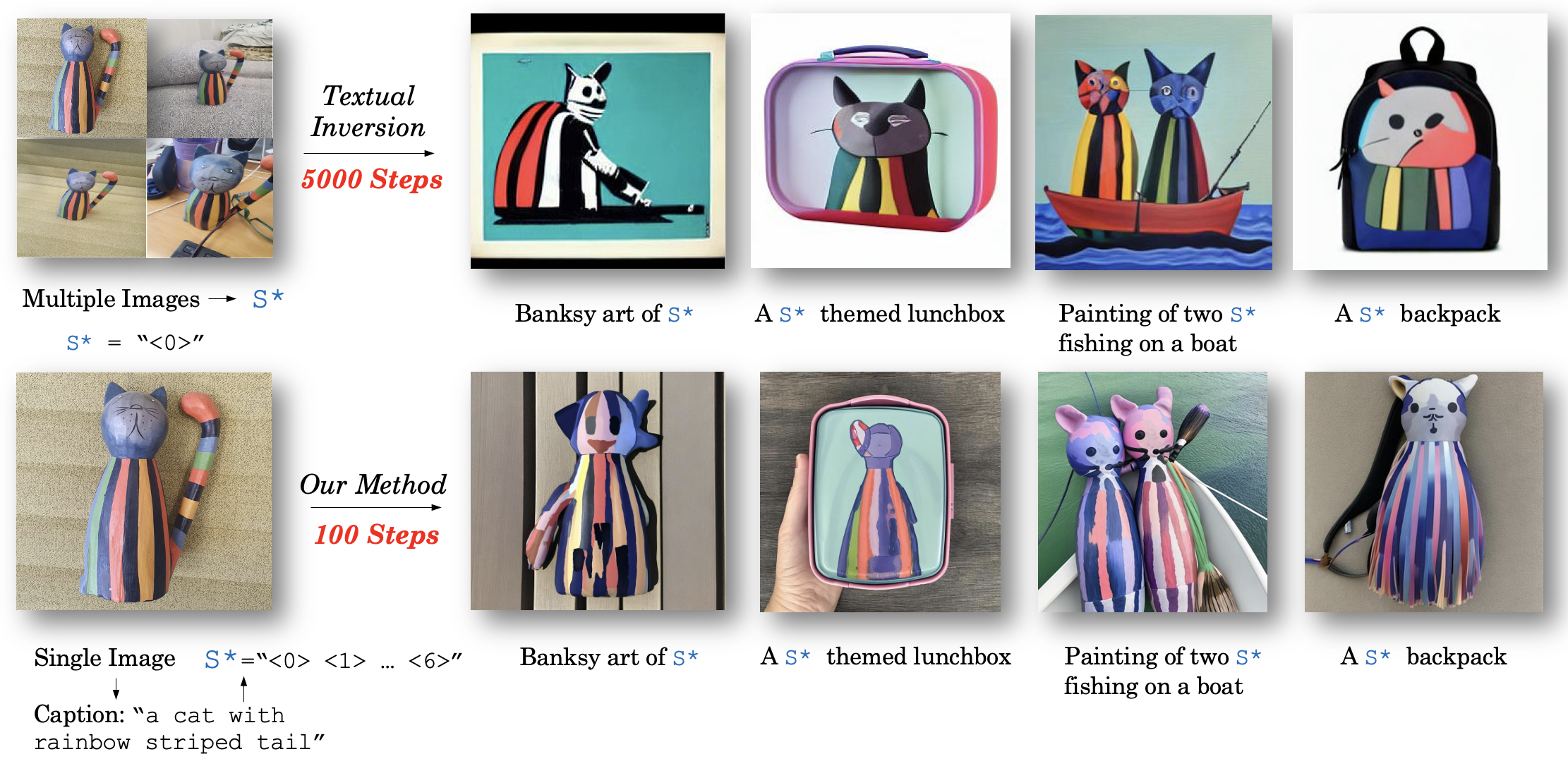
An attempt to improve textual inversion (inverting concept in the image to text in context of text-to-image diffusion models, so that the concept can be re-contextualized with customized prompt) by using off-the-shelf captioning model.
[Important!!!] Paper Writing
For a more comprehensive treatment, I recommand the paper/report we’ve written, where we provide more backgrounds, intutions, and analysis.
Nevertheless, I provide an overview below, assuming the knowledge of vanila textual inversion.
Abstract
Text-driven image synthesis has emerged as a popular research area. Existing approaches to invert image to text face challenges like requiring multiple images, slow convergence, or overfitting thus suffering from editing capability. In this paper, we propose a novel initialization method for inverting text using off-the-shelf (pre-trained) classification or captioning models. This approach enables multi-token embedding learning from a single input image while eliminating the need for fine-tuning and ensuring faster convergence. We demonstrate a significant improvement in convergence speed compared to vanilla TI.
Method
Overall, we modify the original textual inversion by replacing the idea of ‘capturing a concept with a word’ to ‘capturing a concept with a sentence’, and proposed to initialize the inverted ‘sentence’ by off-the-shelf captioning model (classification model can also be used, and we have results related to it in the report. In the following, we focus on the captioning initialization.
Single Image Setting
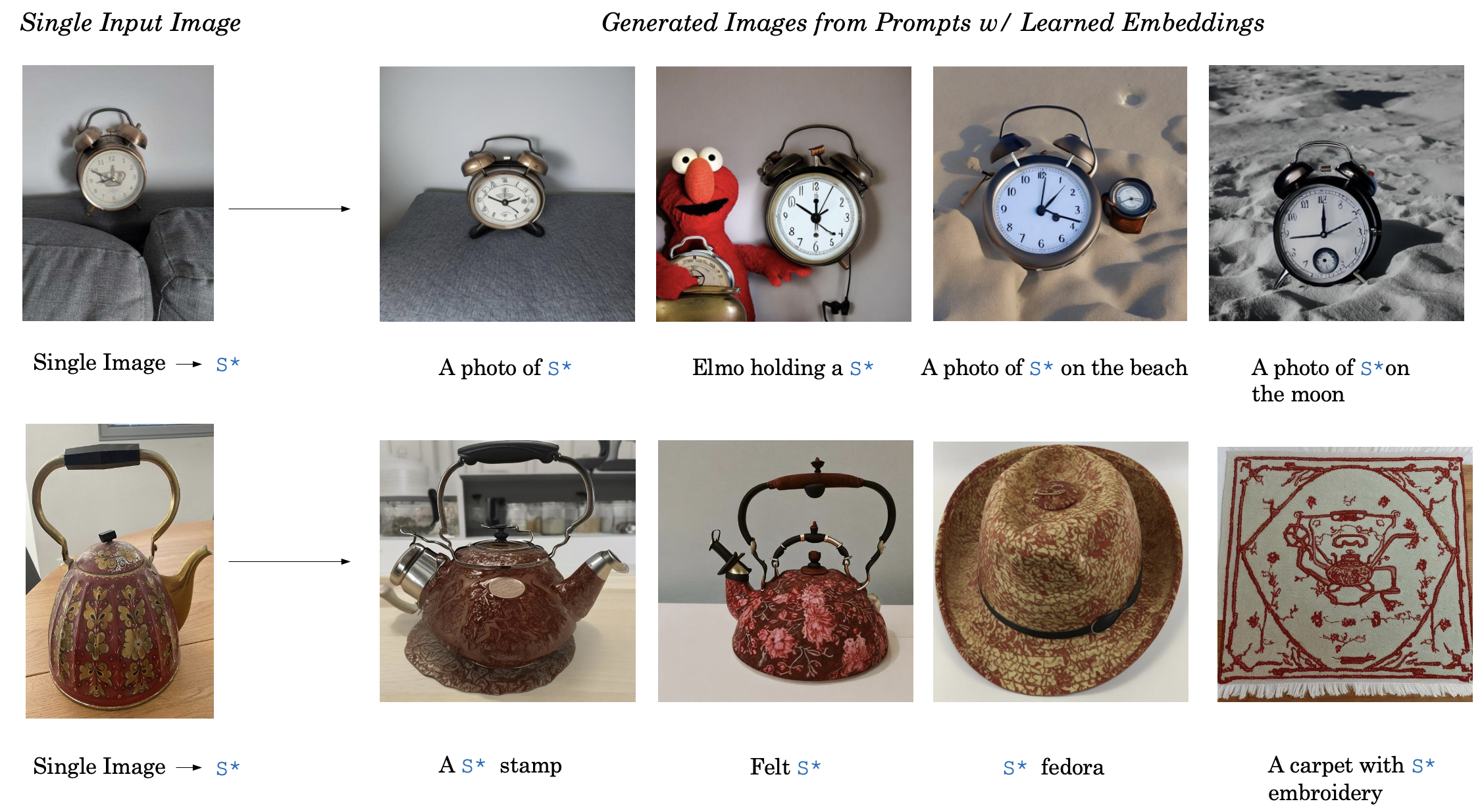
Instead of using multiple captures of a concept (typically 3-5 images in original TI), we use the setting of single image/capture alone, as this is a more realistic setting for real-life use cases. We demonstrate that a single image suffices via some recontextualization examples in the report. However, our main contribution is in the captioning initialization (w/ multi-token inversion).
Captioning Initialization, and Mutli-token Inversion
Instead of representing a concept using only one single “new word”, i.e., a placeholder token <s> as in the vanilla TI, we allow constructing multiple placeholder tokens <0>, <1>, ..., <n>, and denote their corresponding optimizing embeddings as \(\mathbf{v}^{(0)}, \mathbf{v}^{(1)}, \dots, \mathbf{v}^{(n)}\). The specific number of tokens depends on the results of a captioning model as the initialization of word embeddings – we will first fed the image into a captioning model to get a sequence of words.
Results
For more comprehensive analysis like ablation study please refer to the report. Below, we give the training loss convergence, in which we see that captioning converges the fastest out off three cases – initialization by classification, captioning, or a single token '*'. We can observe that our captioning method converges the fastest out of the three. And note that there are many more metrics can be evaluated on generated recontextualized/reconstructed images, such as LPIPS – please refer to the report.
Below, we include some qualitive results of our method. These are generated images from prompts with learned embeddings. We use only 100 optimization steps on a single image (v.s. vanilla textual inversion uses around 5000 steps on multiple iamges) and the results show promising personalization capabilities of our proposed method.
Code
The implementation is simple. We just modify the part of TI’s restricted single word embedding inversion to allowing mutliple word embeddings inversion in the official Textual Inversion github repo. If you would like to know more details about how this is done feel free to contact me and I can send to the specific functions/parts to be replaced from the official repo – we are maintaining the code for other extensions so would not release it yet.